Flat Roof Insulation: PIR, EPS and Tapered Boards
PIR, EPS and tapered insulation are often mentioned together, but they solve different requirements. Product choice depends on thermal targets, compressive loading, roof covering compatibility
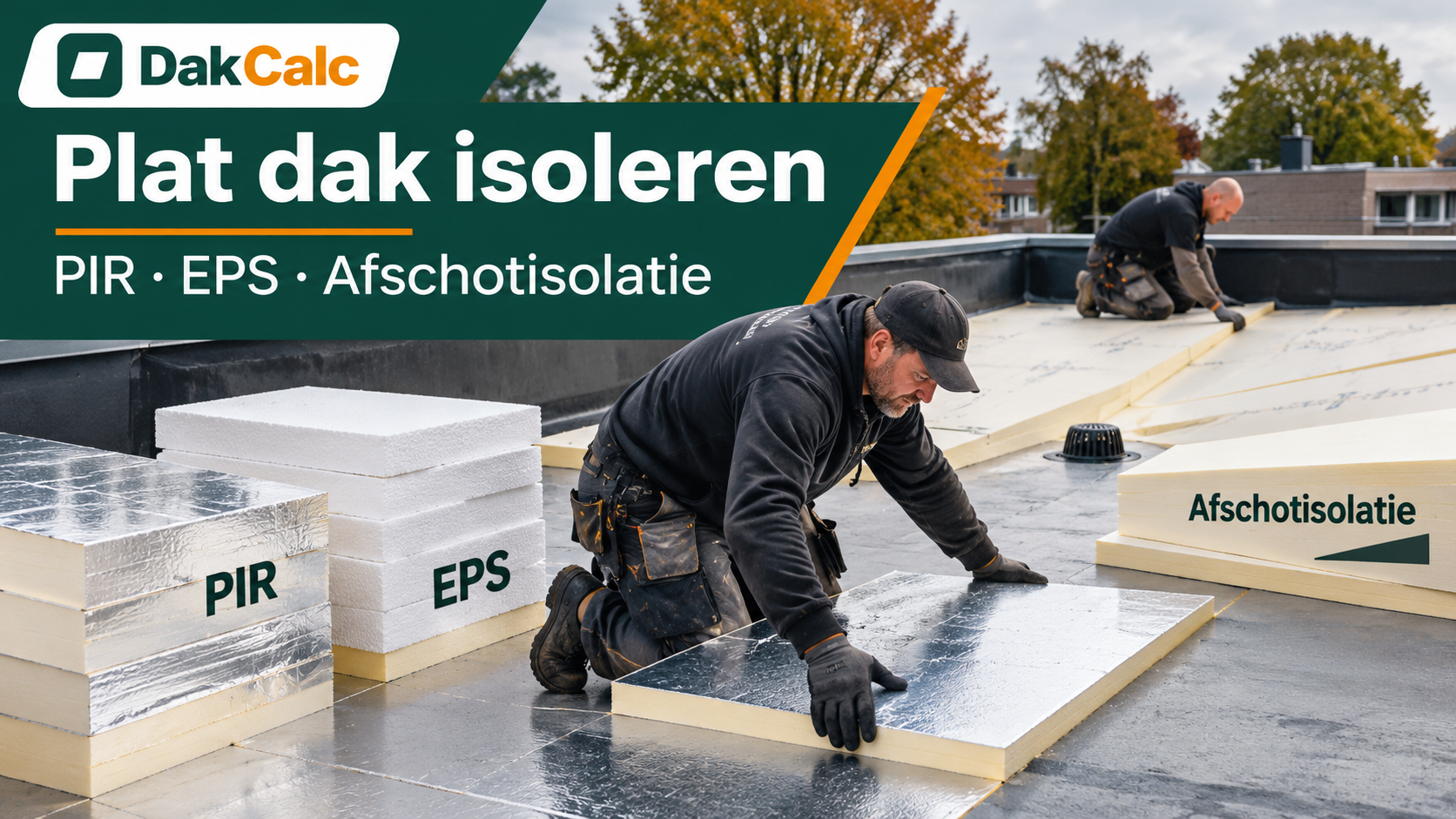
FLAT ROOF TECHNOLOGY · DAKCALC KNOWLEDGE HUB
PIR, EPS and tapered insulation are often mentioned together, but they solve different requirements. Product choice depends on thermal targets, compressive loading, roof covering compatibility and drainage geometry.
Calculate a target build-up from the required construction Rc and declared product lambda, check suitability for the roof system and add a verified tapered layout when required. Price per board alone is not enough.
PIR and EPS are not interchangeable by default
PIR commonly offers lower declared conductivity than standard EPS, so less thickness may be needed for a similar insulating value. Compare the actual product declarations rather than treating all boards alike.
EPS may be suitable in a designed system. Check compressive strength, installation method, membrane compatibility, moisture and fire requirements before selecting either material.
Only specify boards whose documentation permits the intended roof application.
Understand Rd and construction Rc
For a single homogeneous layer, Rd approximately equals thickness in metres divided by declared conductivity. A hypothetical 100 mm PIR board at lambda 0.023 W/(m·K) yields Rd about 4.35 m²K/W.
The legal or design target normally relates to the whole construction Rc, not just the board Rd. Existing layers, junctions and the regulatory calculation method matter.
See Rc versus Rd and verify the Dutch Bbl requirements for the work category.
Plan thickness around details
Draw the build-up and check door thresholds, skylight kerbs, drains and abutments. A thicker board that cannot be properly detailed is not a sound solution.
Use manufacturer pack sizes and actual sheet dimensions to order product. Apply cutting allowance after the layout is known.
Thickness calculations are preliminary until the thermal and technical design is approved.
Flat and tapered boards
Tapered boards can be laid over flat boards or form an integrated insulation package. Because thickness varies across the roof, a single square-metre quantity cannot describe the individual tapered units needed.
Locate drains, valleys, high points and overflow routes first. Check deck deflections and available upstand height before accepting the slope.
Use the tapered layout guide for the next step.
Fixing and installation
Mechanical fastener counts depend on the deck, wind design, product and roof system. A blanket screws-per-square-metre assumption is a costing placeholder, not an approved fixing pattern.
Stagger insulation joints as specified and consider vapour control, airtightness and membrane attachment together.
Example board quantities
A 48 m² roof with 1.2 × 0.6 m boards has a theoretical demand of 48 ÷ 0.72 = 66.67, or at least 67 boards before cutting losses. Actual ordering depends on layout and pack size.
A tapered design also requires a breakdown by thickness and board type. Inventory remaining stock separately from new purchases.
Never treat this example as a final tapered board schedule.
Estimate roofing work with a clear material schedule and cost breakdown
Prepare an initial calculation and verify dimensions, materials, labour and prices before issuing documents.
Open calculator →Explore the DakCalc flat-roof calculation cluster
Start with the calculation hub, three pillars and practical guides for insulation, membrane quantities and roof details.
Frequently asked questions
Is PIR always preferable to EPS?
No. Compare verified product performance and suitability for the specific roof.
Is Rd equal to Rc?
No. Rd describes a material layer, while Rc describes the construction.
Can I order a tapered package without a reviewed layout?
A final layout and product schedule should be checked for the project before ordering.
Sources and further reading
Reviewed in November 2026. Check current rules and software capabilities before relying on them.
General information and illustrative calculations, not personalised legal, tax or technical advice.