Roofing Work Preparation: Complete Project Guide
Good roofing projects begin before the first roll reaches the roof. This guide shows roofers and planners how to turn a survey into a traceable estimate, material order, crew plan, safe work sequence and clear handover.
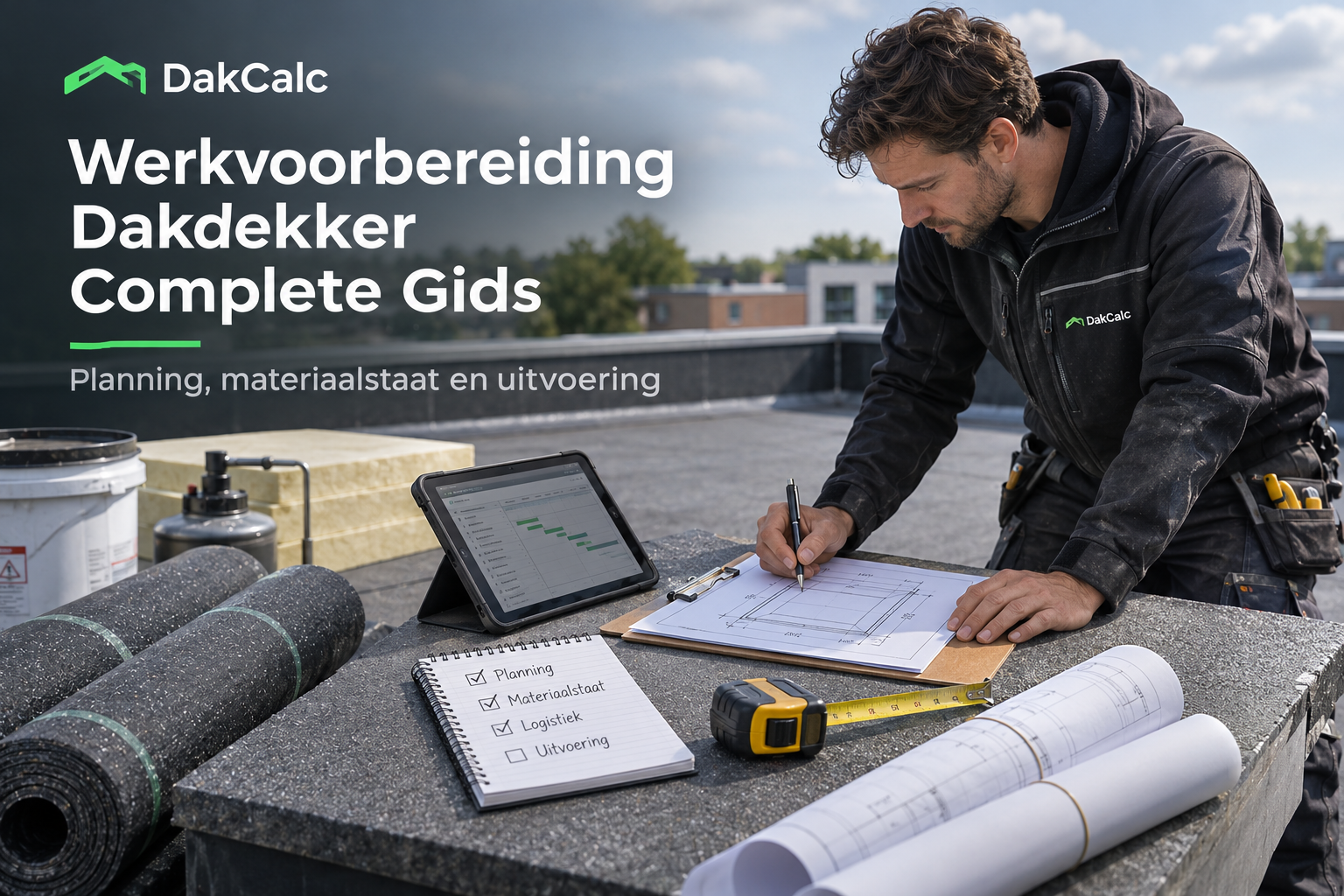
ROOFING · WORK PREPARATION & PROJECT PLANNING
Good roofing projects begin before the first roll reaches the roof. This guide shows roofers and planners how to turn a survey into a traceable estimate, material order, crew plan, safe work sequence and clear handover.
Follow six stages: survey and risk record, technical scope, material and labour takeoff, supplier and crew planning, controlled execution, and an accurate work record. Keep assumptions, existing stock and variations visible.
Start with a dependable roof survey
Measure fields, upstands, edges, outlets, penetrations and existing layers. Photograph access, possible moisture, obstructions, material storage and any unknown deck condition.
Use the survey checklist and survey-to-execution guide. Separate measured facts from assumptions needing investigation.
Agree a technically viable scope
Define repair, recovering or full replacement; specify membrane system, insulation, drainage falls, fixing and junction details.
Read technical roof calculations, renovation planning and repair planning. The Dutch 2025 roofing guideline provides an important system reference.
Estimate materials, labour and uncertainty
Calculate field membranes, strips, outlets, profiles, fasteners and insulation separately, then estimate task-specific labour. Distinguish material installed, stock on hand and packages purchased.
See the estimating process, materials planning and error checks.
A total price without quantities or documented assumptions is hard to control when work changes.
Coordinate crews, deliveries and safety
Check weather windows, crew availability, strip-and-recover stages, roof access, lifting, edge protection and where supplies and waste can be stored.
Project scheduling combines crew hours and logistics. Dutch height-work precautions apply whenever there is meaningful fall risk, not solely above 2.5 m.
Capture what actually happened
Explain task ownership and exclusions before starting. Log variations, materials consumed, man-hours, checks and photographs, seeking approval for extra work before undertaking it.
Use the roofing work order to connect planning, execution and invoicing.
Illustrative flow: survey → scope → quantity takeoff → quote → procurement → scheduling → installation → work record → handover.
From roof survey to material list and job record
Use DakCalc’s available roof area, material and document workflows; verify technical details, site safety and system specifications for each project.
Open calculator →More work preparation guides
Also see: technical roof calculations · roofing quotation.
Frequently asked questions
What does a roofing work planner do?
They translate survey and design requirements into a workable scope, quantities, purchases, crew schedule and site instructions.
Is a materials schedule the same as a quotation?
No. The schedule lists quantities; the quotation sets scope, price and agreed terms.
Does DakCalc replace professional work preparation?
No. Its available tools support estimates and documents, while technical and safety decisions remain with qualified professionals.
Sources and references
Examples are illustrative and are not a site safety plan or engineered roof design. Verify fall protection, structural capacity, wind loading, methods and product specifications before work.