Flat Roof Fall Protection: Edges and Anchors
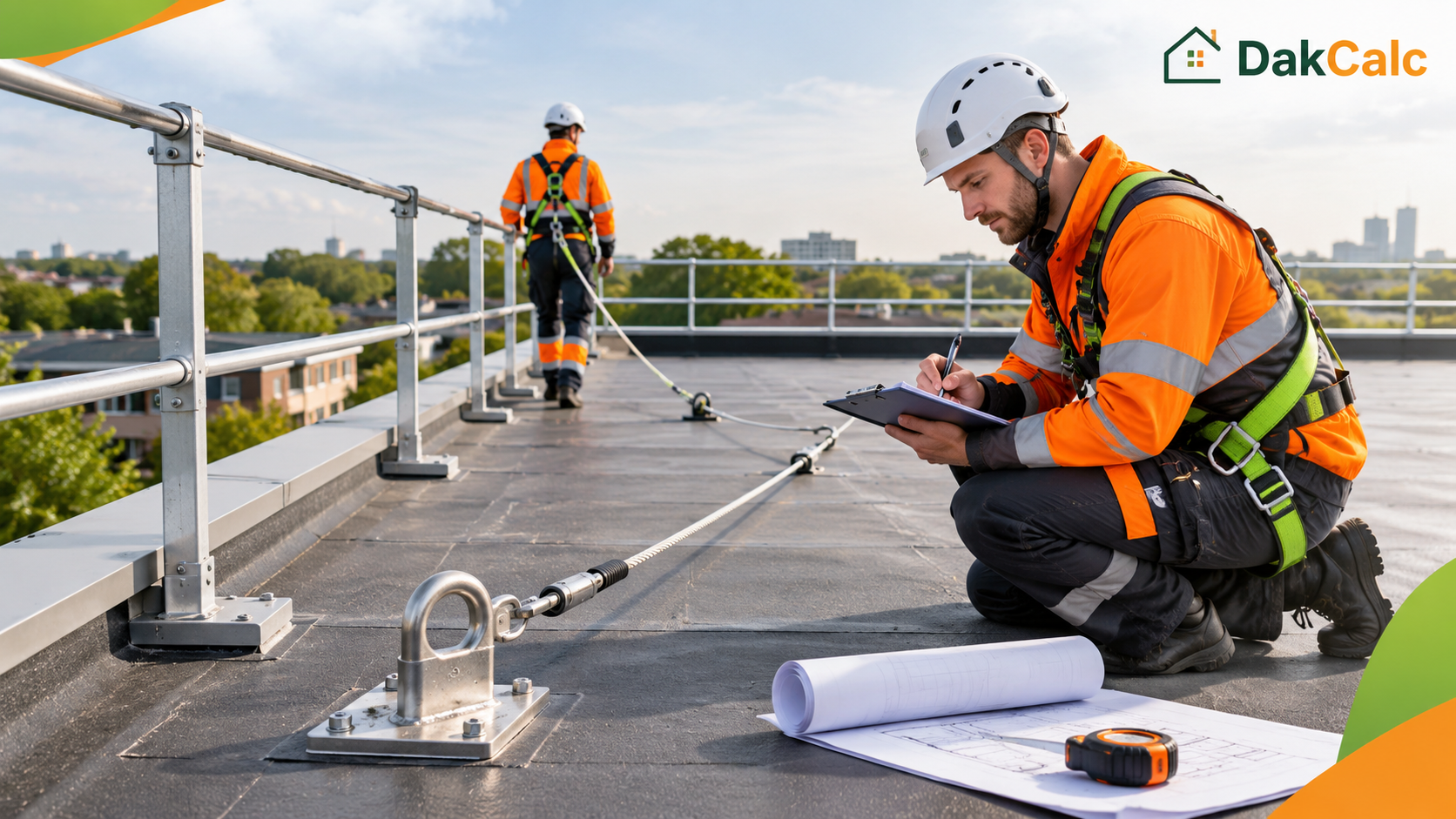
Flat roof fall protection starts by avoiding exposure, not handing out harnesses. Edge guards, safe access, skylights, openings and personal anchors must be assessed as one workplace.
FLAT ROOF · SAFETY, WIND & SOLAR
Flat roof fall protection starts by avoiding exposure, not handing out harnesses. Edge guards, safe access, skylights, openings and personal anchors must be assessed as one workplace.
Prepare a roof-specific risk assessment. Prefer collective protection of edges and openings. If personal equipment is necessary, verify its compatibility, engineered anchors, available fall clearance and a workable rescue procedure.
Map every fall exposure
Identify edges, skylights, service holes and fragile roof panels. Consider hazardous surfaces below and material travel routes.
Read safe working and the site assessment before choosing fall protection.
Prefer collective protection
Use stable platforms, suitable edge barriers and other effective collective measures wherever practicable. Confirm that the chosen protection is approved for the actual roof edge.
Warning tape alone is not automatically adequate, and an ordinary roof trim is not a certified fall anchor.
Arboportaal prioritizes eliminating hazards and collective controls.
Check personal systems and anchors
Where personal fall protection is justified, anchors, connectors, lines, harnesses and energy absorbers must be compatible and appropriate for the required fall clearance.
Rescue after a fall must be possible, and users require training. Do not improvise anchors from unrelated building fittings.
Set inspections and responsibilities
Document equipment checks, access routes, weather limits, rescue arrangements and the persons responsible. Any change in setup calls for reassessment.
Include protection costs and setup time in work preparation and the project schedule.
Build a traceable roofing estimate
Use supported DakCalc tools for roof quantities and costs. DakCalc does not certify wind loads, solar ballast, structural capacity or fall-protection plans; these require appropriate qualified design and verification.
Open DakCalc →Related safety and solar guides
Also see: roofing work preparation · flat roof calculations.
Frequently asked questions
Does a low parapet make a roof safe?
No. Assess the actual fall risk and adequacy of the barrier.
Can a harness be clipped to roof trim?
Not without an engineered and approved anchorage.
Why is a rescue plan needed?
A fallen worker may require prompt recovery; rescue must be feasible.
Sources and standards
- Arboportaal — Werken op hoogte
- Arboportaal — Wettelijke maatregelen tegen valgevaar
- RVO — Geschikte daken voor zonne-energie
- RVO — Veiligheid en verzekerbaarheid zonnepanelen
- IPLO — Noodafvoer en wateraccumulatie
- NEN 7250:2021 — Bouwkundige aspecten zonne-energiesystemen
- NEN-EN 1991-1-4:2026 — Eurocode windbelasting (controleer toepasselijke Nederlandse normeditie)
This guide is informational, not engineering approval or a safety instruction. Confirm applicable standards and national annexes, structural design, manufacturer installation guidance, site risk assessment and insurer requirements.