Bookkeeping for Self-Employed Roofers: From Quote to Invoice
Keep roofing estimates, working hours, purchases, invoices and Dutch VAT in one understandable project administration.
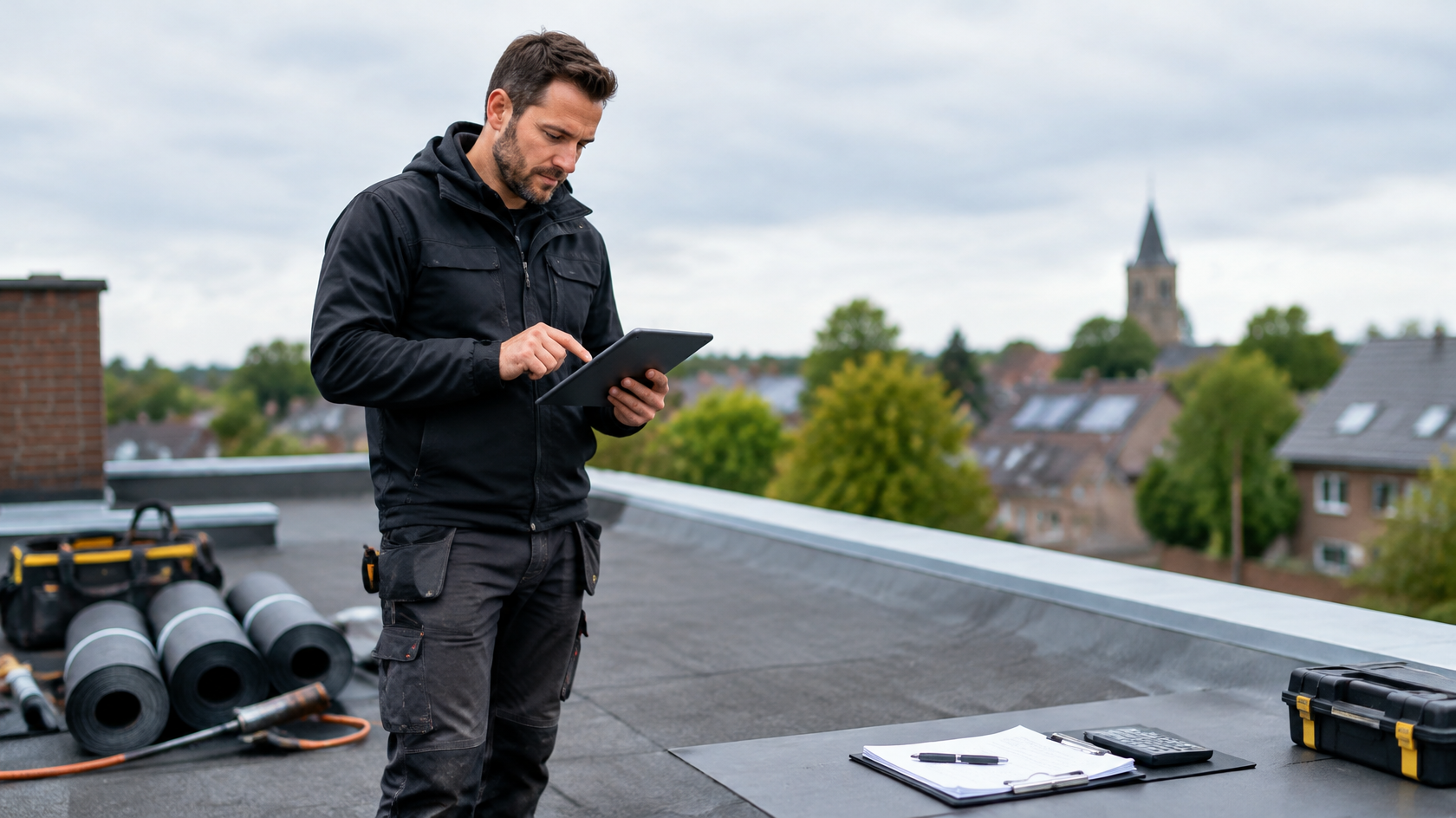
SELF-EMPLOYED ROOFING · DAKCALC KNOWLEDGE HUB
A skilled independent roofer can complete excellent work yet lose track of profit when labour, purchases and invoices are scattered across emails and bank statements. Good bookkeeping follows every roofing job from quotation to payment. The goal is not to become an accountant: it is to know what each job costs, who still owes money and which records must be retained.
Start with a unique project reference and the accepted roofing quotation. Track labour, materials, supplier invoices, receipts, deposits, issued invoices and payments against that job. Keep VAT separate from business revenue, review unpaid invoices and retain records under Dutch tax rules. Ask a qualified adviser about your particular VAT and income-tax obligations.
From quotation to a project record
Give each roof an identifiable reference and store the scope, accepted quotation, photographs, variations and customer correspondence together. Without this, a supplier invoice covering several roofs becomes difficult to allocate.
At acceptance, record the agreed price, instalments and tax treatment. The calculations in the quotation guide remain your baseline budget; additional work should be recorded independently.
- Job reference, customer and site
- Accepted quotation version
- Planned labour and materials
- Signed or documented variations
Supplier bills, receipts and stock
A single roofing merchant invoice may contain goods for several jobs. Allocate expenditure by project while retaining the complete original document. Include skips, hired access equipment, fuel and other relevant business expenses.
Roofing materials taken from your own stock still have an economic cost. Separating material consumption from new orders keeps project profitability meaningful. See the roofing material costs guide.
Track labour and non-billable time
Record site hours separately from preparation, collections, non-billable travel and administrative work. All those activities affect your profitability even when they are not billed individually.
Compare actual hours with your original estimate. If a job planned for 24 hours takes 30, find out why. Use the lesson in your next flat-roof labour estimate.
A fixed labour selling amount of €1,560 represents €65 an hour for 24 hours. At 30 actual hours, effective revenue becomes €52 per working hour.
Turn an accepted job into a compliant invoice
A draft invoice is not the final document. Check numbering, dates, business details, customer details, scope, amounts and VAT before issuing it. Match deposits and approved variations so that the client can reconcile the final amount.
Dutch invoices have more specific requirements than quotations, including an invoice number and information about the supplier, customer, goods or services and tax. Read the invoice checklist.
Separate Dutch VAT from revenue
VAT collected from customers is not automatically yours to spend. Apply the correct treatment and consider deductible input VAT subject to the normal conditions. Certain construction subcontracting invoices use reverse-charged VAT.
An insulation project may require 9% VAT on qualifying labour and 21% on materials. Check the conditions rather than applying one blanket rate. Read Dutch roofing VAT explained.
Review projects and bank payments monthly
Reconcile unpaid invoices against receipts and check which quotations have actually been accepted. A busy month can produce strong turnover but disappointing profit if hours or supplier costs are higher than budget.
Do a simple job reconciliation: estimated costs, actual costs, revenue excluding VAT and the remaining gross contribution. Dutch record-retention obligations commonly run for seven years, with particular property-related records potentially requiring more.
Where DakCalc and accounting software fit
DakCalc provides technical estimates, indicative material lists and document drafts. Accounting software deals with issued invoices, bank transactions, purchases and tax records. Avoid treating a planning document as a posted invoice.
For DigiBoox, use its official supported import formats. Do not assume DakCalc has a direct DigiBoox connector or automatically creates an Excel import file. See the handover workflow.
Estimate roofing work with a clear material schedule and cost breakdown
Prepare an initial calculation and verify dimensions, materials, labour and prices before issuing documents.
Open calculator →Explore the DakCalc roofing business cluster
Start with the hub, the three pillars and supporting estimating and administration guides.
Frequently asked questions
Does an independent roofer in the Netherlands need bookkeeping?
Dutch business and tax obligations require records sufficient to substantiate relevant turnover, expenses and filings.
How long should I retain business invoices?
The usual Dutch general tax retention period is seven years, with longer rules potentially applying to some immovable-property information.
Is a quotation already revenue?
Sending an offer alone does not make it realised sales revenue. Acceptance, performance, invoicing and payment are separate steps.
Can a DakCalc estimate be used as an invoice?
No. A quotation or draft invoice must be checked and converted into a final compliant invoice.
How can I measure job profitability?
Compare actual revenue excluding VAT with materials, labour, transport and other directly attributable costs.
Sources and further reading
Reviewed in November 2026. Check current rules and software capabilities before relying on them.
General information and illustrative calculations, not personalised legal, tax or technical advice.
DakCalc self-employed roofing cluster
Explore connected guides on pricing, roofing estimates, quotations and invoicing.